Opening Summary
General Character of the Subject
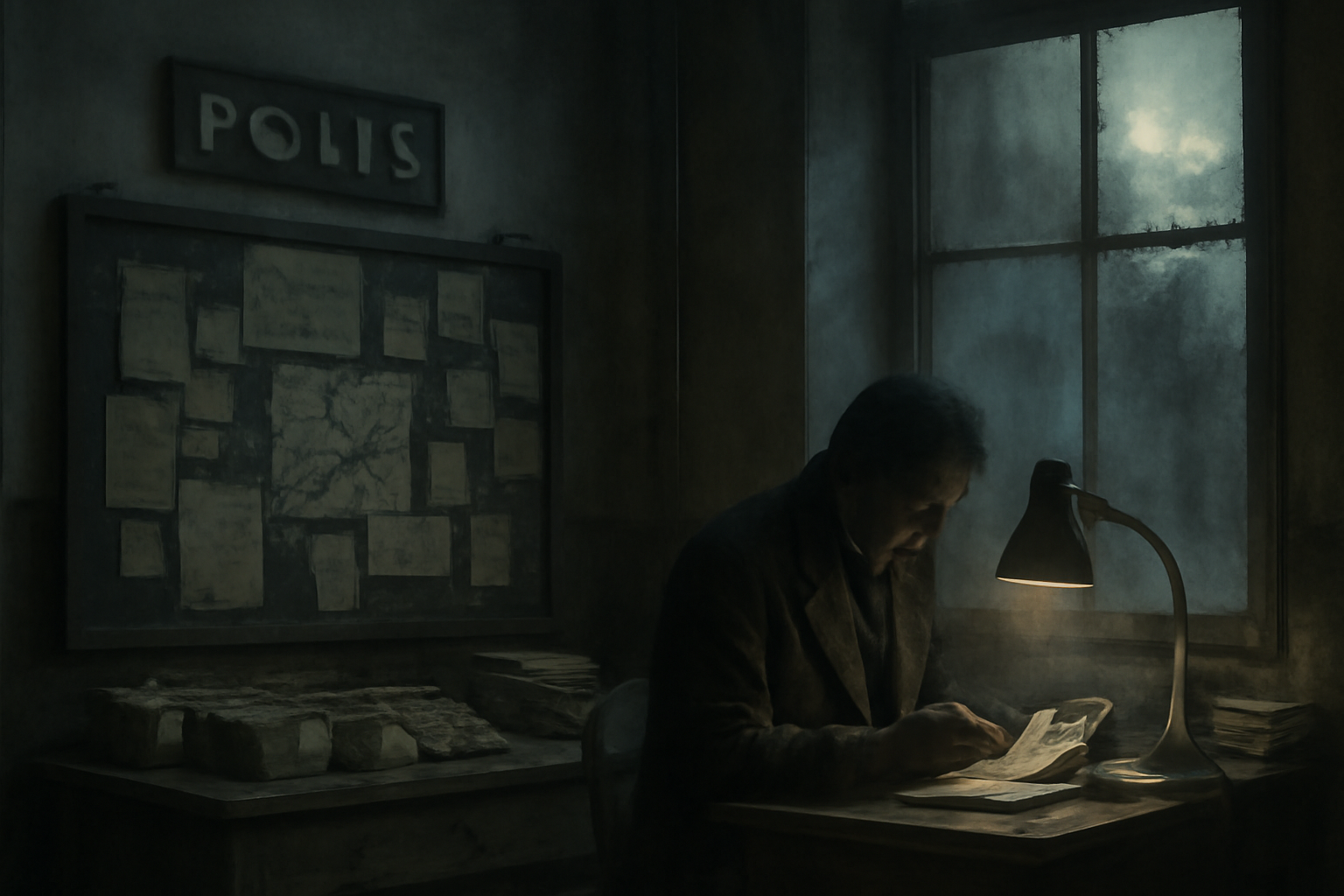
Rydholm is a man in visible decline who continues, infuriatingly, to justify his retention whenever matters become obscure, unpleasant, or politically sensitive. Before his transfer he was spoken of, often with resentment, as one of the detective branch's cleanest minds. He was never popular, but he was respected by those who valued orderly conclusions and by superiors who preferred cases solved without spectacle.
He is not a convivial officer. He is austere in habit, difficult in conversation, and better suited to statements, ledgers, and examinations than to ceremony or public reassurance. Nevertheless, witnesses often speak more freely in his presence than they do in front of louder men. He has the peculiar gift of making a frightened person feel listened to and a dishonest person feel measured.
At present he appears sleepless more often than rested. He drinks, though not always publicly. He is capable of complete stillness during inquiry, followed by abrupt withdrawal once a matter becomes morally tangled or personally reminiscent. This has given rise to accusations of instability. I would describe it more narrowly as strain under accumulated burden.
"Rydholm hears too much and says too little."
"If he writes your name into a report, God help you."
"He used to look like promotion. Now he looks like weather."
Collected remarks from clerks, constables, and one municipal witness. Included not as evidence, but because the subject leaves a strong impression even on those with little direct involvement.
Professional Disposition
Observed Working Tendencies
Toward Witnesses
Excessive Patience with the Vulnerable
The subject shows marked reluctance to dismiss servants, children, laborers, or women as confused when their accounts are inconvenient. This often slows proceedings, but has on several occasions produced useful contradictions overlooked by others.
Toward Procedure
Still Received as Law
However tarnished his reputation, Rydholm remains legible to officials as a Crown officer. He can still extract records, secure interviews, and open municipal doors on the strength of bearing, language, and habit alone.
Method
Incremental Reconstruction
The subject does not trust first impressions. He builds chronology before motive and contradiction before accusation. It is a tedious method to observe, but undeniably effective in complex cases.
Defect
Dangerous Hesitation at Critical Moments
Where immediate command is required, Rydholm sometimes pauses beyond prudence. He appears to require excessive certainty before decisive action, particularly when accusation, pursuit, or public force are involved.
Cause of Inquiry
The Child-Murder Investigation
The decline of the subject dates, by all accounts worth trusting, to a child-murder inquiry conducted while he was still attached to the Upsala detective branch. The father of the child was arrested on the strength of a case Rydholm himself assembled. The arrest satisfied local pressure, aligned with available testimony as then arranged, and was entered into the record without unusual objection.
The accused later died in custody. Whether by illness, despair, or neglect is not the subject of this report. What matters here is that Rydholm thereafter ceased to behave like a man who believed the matter settled. He revisited statements, requested duplicate access to retained materials, and made at least one unexplained night journey connected to the file.
He is reported to have said only this of the case: "I wrote what the evidence proved."
Much later, in drink and in private company, he amended the statement: "I wrote what I needed to be true."
I record this not to endorse gossip, but because every account of his collapse begins there. Something in that case convinced him, rightly or wrongly, that procedure had not merely failed him, but had been made to serve an injustice. Since then he treats accusation as if it were a loaded instrument.
Administrative Consequence
Decline, Reputation, and Transfer
Following the above inquiry, the subject's deterioration became too visible to ignore. Reports were filed late. Appearances grew irregular. Rumors of drink began as jokes, then hardened into expectation. Men who once complained of his severity learned to pity him, which he appears to despise more than contempt.
His transfer to Sundmyra was outwardly practical: a quieter post, close enough to Upsala for recall, far enough to remove him from the center of discussion. Unofficially, it was the customary disposition for a capable officer whose presence had become awkward. The decision preserved his utility while relieving the branch of the spectacle of his decline.
He has retained his rented rooms in Upsala, paying for absence in order to postpone the fact of removal.
Inventoried among his effects: one sealed case file marked "Far"; one cracked pocket watch no longer keeping reliable time; one small church token rubbed nearly smooth through habitual handling; numerous notebooks in a disciplined hand.
Field Observation
Arrival in Sundmyra
The subject arrived in Sundmyra on a rain-damp morning with one trunk, one valise of papers, and the look of a man determined not to let any witness see what the journey had cost him. Several locals later remarked on the coat first: good cloth, city cut, too fine for the road, and worn by somebody who had either held status recently or could not yet admit he had lost it.
He took stock of the village in the manner of an officer assessing a scene rather than a resident arriving home. He looked at the church, then the road, then the tree line. He spoke little. He tipped the driver correctly. He carried his own papers. By evening it was already being said in the inn that the new constable had the face of a man listening for something no one else could hear.
Description
Physical Presentation
Male, late thirties to early forties, tall and lean, with the rigid economy of movement associated with well-schooled investigators and men who have spent too long mastering their own expressions. The face is gaunt, the complexion pale, the mouth habitually set as if in silent objection. He is not handsome in any generous sense, but he is difficult to overlook.
Particular note should be made of the left eye, which appears washed amber or yellowed in contrast to the right. I cannot determine whether this is an old injury, a fever aftereffect, or simple discoloration, but it gives his stare an unsettling asymmetry that has been remarked upon by multiple witnesses. Hair dark brown, usually well-parted but disturbed by habitual handling. Fingertips stained by ink. Minor tremor observed in the left hand on two occasions.
Chronology
Known Sequence of Deterioration
Branch Reputation Established
Rises in quiet esteem within the Upsala detective branch as a patient and exacting investigator.
Child-Murder Inquiry
Assumes direction of a case involving a dead child and conflicting testimony from distressed rural parties.
Arrest and Custodial Death
The father is arrested under Rydholm's theory of the crime and later dies while confined.
Irregular Conduct Begins
Subject revisits the file, requests access after hours, and begins showing signs of exhaustion and preoccupation.
Professional Decline
Late reports, visible drink, erratic demeanor, and increased conflict with colleagues over standards of proof and arrest.
Transfer to Sundmyra
Removed from the center of the branch while retaining nominal usefulness to the Crown.
Persons of Interest
Associates and Relevant Witnesses
Supplementary Notes
Habits, Defects, and Persistent Rumors
Observed habits
- Counts his steps at crime scenes.
- Rewrites witness statements in perfectly measured script.
- Sometimes conceals liquor in bottles labeled for evidence storage.
Noticeable aversions
- Wet wool, lullabies, and the sound of cell doors produce visible strain.
- Recovers composure through writing, black coffee, and formal procedure.
- Will not force confessions or leave a child witness unattended.
Persistent rumors
- The child-murder file was never as settled as the official record suggests.
- Someone in authority may have preferred the original conclusion to remain untouched.
- The dead father's surviving kin may yet pursue the matter.
Temperamental residue
- Shows signs of believing that one properly handled case might still restore him.
- Increasingly treats judgment as something to be feared rather than wielded.
Filing Officer's Conclusion
Assessment and Recommendation
Rydholm is not fit for prominence, public-facing reassurance, or cases that demand brisk certainty for political reasons. He drinks too much, sleeps too little, and carries himself like a man who has privately revised the terms on which he understands guilt. Yet it would be foolish to confuse damage with uselessness. He remains difficult to deceive, exact in documentary habits, and unusually attentive to the people most officers ignore.
My judgment is that he should neither be promoted nor discarded. In the wrong setting he will continue to decline. In the right setting, particularly where confusion, silence, or local power have obscured the truth, he may still do work that better men cannot.
Filed by Sergeant A. Nyberg, acting on instruction from the Upsala police authority, for restricted internal circulation.
Recommendation: retain under observation; assign only where patience, discretion, and unpleasant persistence are of greater value than cheerful discipline.